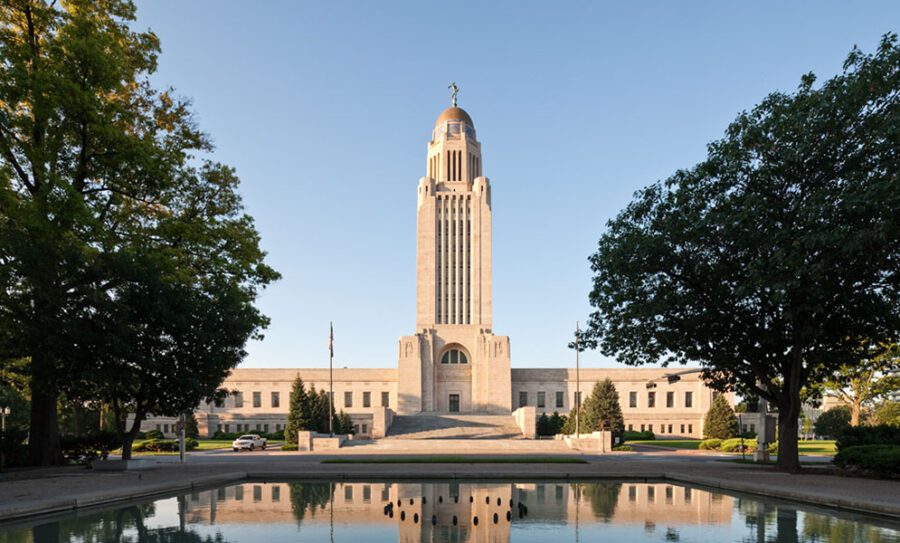
Nebraska’s 1875 constitution opened its Bill of Rights with a promise about conscience: “No person shall be compelled to attend, erect or support any place of worship against his consent, and no preference shall be given by law to any religious society, nor shall any interference with the rights of conscience be permitted.”
A lawsuit filed this August shows why that promise belongs at the center of the education debate.
In Jacobsen v. Spellerberg, the New Civil Liberties Alliance represents two Lincoln families challenging the state’s education system. Nebraska requires parents to educate their children under threat of criminal penalty, yet provides that education only through public schools. Families who homeschool or choose a private school forfeit tens of thousands of dollars in benefits available to families who accept the government’s curriculum. NCLA’s argument begins with three words: “Education is speech.” A state that conditions a benefit on accepting its message, NCLA argues, is practicing viewpoint discrimination.
Is New Civil Liberties Alliance Correct?
NCLA is right. Its argument also goes further than the lawsuit does.
If education is speech, what kind of speech is it? All education is religious. Liberty University law professor Jeffrey Tuomala has shown that, as Madison understood the term, religion covers not only worship and prayer but education as well. Those who built secular schooling have said the same. In 1930, Charles Francis Potter, who later signed the first Humanist Manifesto, called education “a most powerful ally of Humanism” and declared that “every American public school is a school of Humanism.” Even the Supreme Court has heard the warning. Dissenting in Abington v. Schempp (1963), Justice Potter Stewart wrote that stripping religion from public schools could be seen “not as the realization of state neutrality, but rather as the establishment of a religion of secularism.” Every curriculum rests on religious assumptions about chance or design, chaos or order, whether there is a God and whether that matters, what man is, and what is true and good. Even silence about God teaches that He does not matter. Splitting schooling into “secular” and “religious” does not create neutrality. It lets the state set up an orthodoxy of its own.
That means whenever the state funds education, it takes a side. No curriculum exists without a worldview, and no worldview exists without religious assumptions. When Nebraska funds public schools, it funds one set of answers to life’s deepest questions and compels every taxpayer to support them, with or without his consent. The constitution names places of worship, but its principle is broader. Conscience may not be conscripted through taxation.
What Can One Learn from Orwell?
In George Orwell’s 1984, the Ministry of Truth existed to decide what was true. It rewrote the historical record, controlled the language people used, and made sure every citizen received the Party’s version of reality and no other. Its name was the first lie it told, since its real work was the opposite of truth.
Government education has become something not unlike it. The state decides which books are assigned, which history is taught, which questions may be asked, and which answers count. It compels children to attend, compels parents to pay for it, and calls the result neutral. Nebraska’s scheme completes the picture. Parents are required by law to educate their children, and the only education the state will fund is its own version of the truth. Families who dissent are free to teach otherwise, but only after paying for the state’s version and then again for their own. A ministry that defines truth for every child, funded by every taxpayer, is exactly what a free people should refuse to build.
Funding every family’s choice equally does not solve the problem. It compels taxpayers to support every religious worldview instead of one. The funder still writes the rules for what qualifies, and the power to define what qualifies is the power to give preference. This is nothing new. Wherever public money follows the child, the funder decides what qualifies.
The plaintiffs in Nebraska do not seek to end or defund public schools, but we believe their argument naturally leads there. If the government cannot fund educational speech without funding religious worldviews, the government cannot remain logically consistent by being in the education space at all.
Pillar 1: Independent Parents
God trusts parents with their children and so should we; therefore, we affirm that parental rights come from God and should be protected from the state.
Nebraska already admits half of this principle. It requires parents to educate their children and threatens them with criminal penalties if they fail. A duty that heavy only makes sense if the authority comes with it. The state assigns parents the responsibility, then uses its funding to claim the authority for itself. A right that comes from God is not the state’s to ration through funding. Parents who direct their children’s education according to their own convictions are not opting out of a public duty. They are fulfilling it.
Pillar 2: Independent Funding
Education is the responsibility of the family, with support from fellow believers; therefore, we recognize that the financial obligation remains on parents, with support from private, voluntary benefactors.
Voluntary support is the only kind of funding consistent with a constitution that forbids compelled support “against his consent.” A parent who pays for his child’s education, or a benefactor who chooses to help, funds a worldview he embraces. A taxpayer compelled to fund the state’s curriculum does not. When the financial obligation stays with families and voluntary benefactors, conscience stays free and ownership stays with parents.
Pillar 3: Independent Pursuit
The purpose of education is to know God and to make Him known; therefore, we uphold that the sacred pursuit of education exists outside the jurisdiction of the state.
Nebraska’s constitution calls worship a natural and indefeasible right, exercised according to the dictates of conscience. Education aimed at knowing God is exactly that kind of pursuit. The state has no more authority to fund, define, or reward it than to build a church and compel attendance.
Pillar 4: Independent Ideas
Wrestling with Truth promotes blessing and virtue for the whole community; therefore, we conclude that a flourishing society emerges from a free market of ideas.
NCLA’s case rests on free speech, and free speech depends on a free market of ideas. When the state funds education, it becomes the largest speaker in every child’s life, with the power to decide which ideas are taught and which are left out. That is how a Ministry of Truth is built: not by banning dissent, but by funding one version of reality and making every other version pay twice. A community cannot wrestle with Truth when the state has already settled the answers. A flourishing society needs many teachers, many traditions, and many voices, none of them owned by the state.
Nebraskans wrote the answer into their constitution more than 150 years ago. Education Independence asks only that we take it seriously. The answer is separation.
Written by: