Back to our Roots
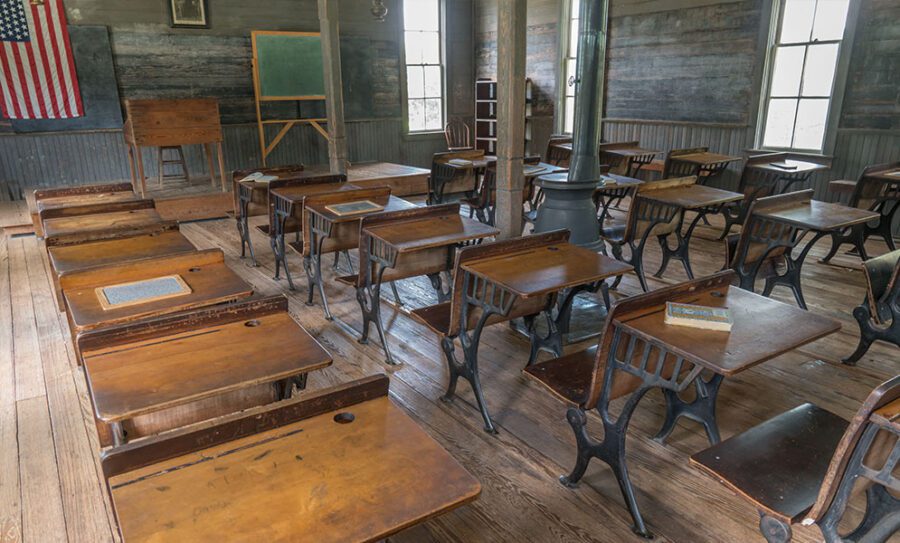
Imagine a small schoolhouse and a teacher who chooses the schoolhouse size and the age range they instruct.i The teacher has a direct relationship with the students’ parents, and authority is delegated within that relationship rather than exercised by the State. The parents and the teacher share in curriculum development and in the length and persistence of school days. They can decide whether the students will attend all day or only part of the day. The parents pay the teacher directly, and the teacher shares administrative duties. The only role of the State is to ensure that the rights of parents and teachers are protected to enact such a vision. What could be accomplished between a teacher and a parent with minimal State intervention? Does this type of approach have merit?
For generations, many American children learned in one-room schoolhouses where a single teacher instructed students of different ages and abilities. The school was rooted in the local community: families helped build and support it, teachers worked directly with the children entrusted to them, and the schoolhouse often served as the community’s social and civic center. The Freeman School at the Homestead National Historic Park in Nebraska offers a glimpse into the history of American education practice.ii For ninety-five years, the parents hired the teacher and provided the curriculum, materials, and location for instruction. Any government intervention that occurred was decided by the local community, those living in the area where the school was located.iii Control and responsibility for education were exercised overwhelmingly at the local level.iv The teacher, by virtue of their position in the community, had a vested interest in the children’s success.
Creating Institutional Friction, the Mandate of the Common School
In public education today, friction arises between the roles of teachers and parents. Indeed, Horace Mann, the father of the modern public education system, called for teachers and administrators to share parental duties while students are present at the common school.v The marks of Mann’s dogma are still ever present in the current public education sphere. The separation of children by grade level, the imposition of permanent taxes to fund public education, and the diminishing role of the parent are all attributes of Mann’s approach to “save the republic.”vi Arguably the most damaging aspect of Mann’s approach was his call to teachers not to use controverted political or constitutional questions in the classroom and, if they arise, not to allow the students to engage in dialogue. How is a student to be properly formed if they cannot engage in debate and wrestle with difficult and ethical topics? Mann’s philosophy sets the stage for twentieth- and twenty-first-century conflicts between parents and teachers.
The teacher within a large institution does not choose the standards they are required to teach, nor do they determine the size of the classroom entrusted to them. They may exercise judgment within those constraints, but they do not possess final authority over discipline governance when the need arises. Even the measure of professional effectiveness is tied, in part, to student achievement as defined by the institution, rather than to whether students are becoming knowledgeable, thoughtful, self-aware adults. When a student acts out, parents are often called upon to correct behavior that occurred in an environment they did not witness and do not control. Yet what is the parent to do when the child spends at least thirty hours each week at school?vii The administrative burdens placed upon teachers further complicate the relationship by limiting the time and authority available for sustained formation. That continuity is weakened again as students move from grade to grade, teacher to teacher, and classroom to classroom. This raises an uncomfortable question: who is exercising the greater formative influence over the child: the parent or the public school system? The familiar response to student misconduct, “Where are the parents?” exposes the tension. Teachers may feel they lack the authority to address persistent behavioral problems, while parents are expected to correct conduct that is cultivated or expressed during hours when the public education system exercises immediate supervision. The resulting conflict is not simply between parents and teachers; it is a conflict created by divided authority and responsibility. That flashpoint leads to the next question both must confront: what do love and sacrifice require?
Love for the Students
The article titled “Education Independence and the Weight of Responsibility” addressed the relationship boundaries between a student and a teacher. It grappled with whether a teacher can love the students they teach. Denying that teachers in the public education system, let alone any education system, sacrifice for their students would be indefensible and dismissive. One need not look far to encounter stories of teachers who must purchase the very tools they need to teach. Furthermore, in NC, many news articles cover issues related to teacher compensation. Many teachers must work several additional jobs to make ends meet. Even though the call to empathy is strong upon hearing these testimonies, a question that arises is: what keeps teachers working within the government public education system?
In the first five months of 2026, at least three teacher walkouts occurred on school days to draw attention to compensation and funding issues.viii Irrespective of the grievance’s validity, a school-day walkout imposes immediate consequences on students and their families.ix Even though the teacher may care and expend personal resources to instruct students in their charge, the public education system can place the teacher, student, and family in structural opposition, even when their interests should be aligned. The teacher, parent, and student should all be oriented toward the student’s growth in self-awareness through a relationship with the Lord.x When authority, responsibility, time, and influence over a child’s education are divided among parents, teachers, administrators, and the State, the question of who is ultimately responsible for raising the child becomes unavoidable: who is raising the next generation—is it the government through the public education system or the family?
A Teacher’s Freedom
America has a long history of overcoming adversity through self-discipline, self-governance, and self-control. Even Horace Mann saw the value and necessity of developing these three principles in the next generation of Americans.xi These principles are not a rejection of external support, but an affirmation that local communities are often best positioned to understand and solve the problems directly before them. The US Army has an adage that the soldier closest to the fight will most often have the best understanding of the situation. This same axiom has demonstrated its accuracy and applicability throughout American history and can be applied to freeing teachers from government scrutiny, overreach, and bureaucratic intransigence. Communities have united around compensating teachers with a salary, a place to live, and the tools needed to educate children. Understanding how it was done in the past can inform future ideas. The past need not be recreated exactly, but it can remind us that another model is possible. Consider the exordium: a teacher establishes a business in which the teacher and parents determine curriculum, the size of the schoolhouse, the number and length of school days, discipline governance, and fair compensation for the teacher’s time and expertise. Education independence is not merely a model for homeschooling; it restores authority to direct the formation and instruction of children to the family while allowing teachers to exercise professional judgment in direct relationship with those families.
A teacher who chooses to step outside the government public school system is not abandoning education, but reclaiming the ability to teach without surrendering judgment to an institution whose understanding of the purpose of education may differ fundamentally from that of the family. In such a relationship, parents retain the authority and responsibility for the formation of their children, teachers bring their knowledge and professional skill to that work, and students are given the opportunity to grow in knowledge, virtue, self-awareness, and an understanding of their relationship with God. Education independence can free teachers by returning professional judgment to teachers, authority and responsibility to families, and the work of formation to the relationships in which it properly belongs.
i Douglas Harper, “Etymology of ‘Class,’” in Etymonline (Douglas Harper, 2026), https://www.etymonline.com/word/class?. The word “class” entered English around 1600 to describe a group of students, particularly students of the same grade or level of study. It derives from the Latin classis, meaning a division, rank, army, or fleet, and was used in Roman society for groups of citizens organized according to wealth, taxation, and military obligation. The root is probably related to the Latin calare, “to call” or “summon.” Thus, the underlying idea of a class is not simply a room of same-aged children, but a group called together or arranged according to a common characteristic, rank, or purpose. The author chose the term “schoolhouse” over “class” due to the sharp distinction in groups that the term “class” invokes. Looking back at the roots of American education, students were all formed and instructed in only a few rooms. This type of approach led to the older students helping the teacher instruct and form the younger.
ii National Park Service, “Freeman School at the Homestead National Historical Park,” Government, National Park Service, National Parks Service, 2026, https://www.nps.gov/places/freeman-school.htm?utm_source=doi_chatbot&utm_medium=referral.
iii Carl F. Kaestle and Eric Foner, Pillars of the Republic: Common Schools and American Society, 1780-1860, 1st ed, American Century Series (Hill and Wang, 1983).
iv An argument is often made that, since the parents may have voted to apply a tax to cover the expenses of the teacher and the school, it sets the precedent for state and federal government involvement in the formation and instruction of children. On the contrary, both the government officials and the parents were one and the same; they had both a vested interest and the choice to tax themselves to support the education endeavors in their community. This critical distinction separates local self-government from later state and federal involvement.
v Horace Mann, “Ninth Annual Report (1845),” in The Republic and the School; Horace Mann on the Education of Free Man, ed. Lawrence Cremin, Classics in Education 1 (Columbia University Teachers College, 1957).
vi Horace Mann, The Republic and the School; Horace Mann on the Education of Free Man, ed. Lawrence Cremin, Classics in Education No. 1 (Teachers College Press, Teachers College, Columbia Univ, 1957). The introduction of this collection of works thoughtfully articulates Mann’s philosophy and the necessity for revolutionary change in education. Mann saw the republic as losing its identity since the population was not formed according to the needs of a stable republic. Mann discusses the need for common and public education to be child-centric; however, although not explicitly stated, his dogma points to his wholehearted belief that the State is the center of common cultural identity.
vii The math is based on five days a week of six-hour blocks of instruction. This metric does not include extracurricular activities, transportation to and from the school, and time required to address homework tasks. The number of hours a child devotes to public school requirements can nearly double once transportation, extracurricular activities, and homework are included, further reducing the time available for sustained parental influence.
viii John Dowding, “NC Educators, Teachers Skip School to Rally for Pay Raise, Funding for Public Schools,” Commercial (.com), ABC 11 – Raleigh-Durham (WTVD), ABC 11 WTVD, May 1, 2026, https://abc11.com/post/thousands-rally-raleigh-calling-more-funding-north-carolina-public-schools/19013992/; James Farrell, “Teachers at Dozens of NC Schools across the State Could Walk out Wednesday,” Organization (.org), WHQR Public Media, Morning Edition, WHQR Public Media, January 6, 2026, https://www.whqr.org/2026-01-06/teachers-at-dozens-of-nc-schools-across-the-state-could-walk-out-wednesday; ABC 11, Raleigh-Durham (WTVD), “Teachers Rally in Wake County as District Weighs Special Education Cuts,” Commercial (.com), ABC 11, ABC 11 WTVD, March 19, 2026, https://abc11.com/post/wake-county-teachers-walk-protest-18m-proposed-special-education-cuts/18734592/. According to the “Highlights of the North Carolina Public School Budget,” released in March 2023, North Carolina spends between $12,000–$13,000 annually per student in public education. Ninety-four percent of local public school system expenditures in North Carolina went to compensation and benefits. NC Department of Public Instruction, Highlights of the North Carolina Public School Budget (NC Department of Public Instruction, 2023), https://www.dpi.nc.gov/documents/fbs/resources/2023-highlightspdf-0/download?attachment.
ix On social media platforms, comments on posts regarding the teacher walkout repeatedly express some variation of “increasing compensation by making the parents feel it.” These comments are anecdotal, but they reveal an adversarial instinct that can surface during institutional conflict: some observers are willing to treat disruption to families, and by extension, children, as an acceptable means of applying pressure.
x If a person does not believe in God, the concept of education is not lost. Formation can be geared toward growth in self-awareness through a strong moral code and ethical principles. Even though the formation will have gaps and be incomplete, the possibility of wrestling with virtue is still achievable. The primary issue that arises with public education is that students do not wrestle with the philosophy of virtue because the original intent of Mann’s common school conception was to avoid controversy and teach to common understanding.
xi Horace Mann, The Republic and the School; Horace Mann on the Education of Free Man, ed. Lawrence Cremin, Classics in Education No. 1 (Teachers College Press, Teachers College, Columbia Univ, 1957).
Written by: