Part 8 of the Build an Ark series by Education Independence
Last month, we asked how we “we,” or alternatively stated, how a healthy coalition holds a shared goal around freedom without accidentally defaulting to how one ought to use one’s freedom. This installment asks the next question in the spiral. Once the “we” is clear, how does it build?
If you can remember back to the previous installment on building, we named the method from the First Amendment of the US Constitution, restated in five verbs: submit, speak, publish, convene, and defend—the constituent activities of building an independent space within society. At the same time, our method is philosophically grounded, yet practical and visible, modeled right now in the work of building this vision of a separate, independent education economy. Any of us who thoughtfully teach, instruct, lead, or mentor know that we cannot pass on what we do not practice. So, consider both the model and the exercise, offered so that anyone building their own “we” can see what these verbs look like in motion, and borrow the shape for their own family or work.
Submit
Building begins with submission to an authority higher than preference. In practice, Education Independence carefully and purposefully articulates four pillars of conviction—Independent Parents, Independent Funding, Independent Pursuit, and Independent Ideas—and holds them up as authoritative in our work. Everything in the organization’s work answers to those four points. On the one hand, honest convictions carry a real risk of division within a community. On the other hand, without them, you’re driving a boat without a rudder. Structurally, this is the idea of submission. It is the defining element, the plumb line, that you do not allow to be renegotiated every time it becomes inconvenient.
Speak
The act of submitting to conviction produces something to say, and building something with anyone other than just yourself requires communication. Education Independence says the hard things out loud, even when they are countercultural. We think out loud, both in public and online, for an audience that does not always share our convictions. We wrestle with ideas, knowing we might make mistakes, because that public risk is the only path to real refinement. Speaking is the exposure and the invitation to correction. It takes courage to test ideas where others can see, and that’s true for anyone trying to build strong movements with others.
C. S. Lewis said it best:
“Courage is not simply one of the virtues, but the form of every virtue at the testing point, which means, at the point of highest reality. A chastity, or honesty, or mercy, which yields to danger will be chaste or honest or merciful only on conditions. Pilate was merciful till it became risky.”
— C. S. Lewis, The Screwtape Letters
A conviction that you will only speak when it is safe to speak is not really a conviction. It has not been tested, so you do not know how honest you actually are. Speaking out loud in public when it is not safe to do so is the testing point Lewis describes: the moment a conviction either proves real or quietly gives way.
Publish
Since what is spoken must be preserved, or it evaporates, Education Independence is building a canon: a growing body of thought on what education independence means and requires. This is published across platforms so it can be found, cited, and built upon by others. Publishing turns a conviction into a record, and that record can inform a movement and invite a supporting crowd long after the people who first spoke it are gone.
Convene
In society and in the political sphere, we embrace the idea that power is derived from the consent of the governed and is expressed through representation. Our published ideas are only as powerful as the size and scope of the community that gathers around them. Education Independence convenes both virtually and in person, building a network of families and advocates and forming partnerships with other organizations. This is the necessary coalition-building around a shared conviction that can shape how we influence our own government through our advocacy and our votes.
Defend
Previously, we named “defend” as the sword of argument, reason, publication, and accountability to the public. That definition still holds. As this work matures, defending grows beyond arguments into tangible action in the public arena. As for Education Independence, that means unpacking policy in detail, advocating for the separation of education from government control, and building the political capital required to have an impact on our government when a bill or a rule threatens one of the four pillars. This is still peaceful. It is still built on consent and not coercion, which is the same distinction that separates the economy of freedom from the economy of force. It is no longer only rhetorical in the sense that it is just words, but it is rhetorical in the sense that this is the political fruit of ideas fleshed out to the degree of implementation. It is the sword of argument extended as the sword of political action.
We are just at the beginning and still under construction, which is fitting, since our ark is a structure we are building while we already live inside it. Submit, speak, publish, convene, defend—five verbs, one pattern, and an open invitation to join our effort or follow this example.
Where Do We Begin?
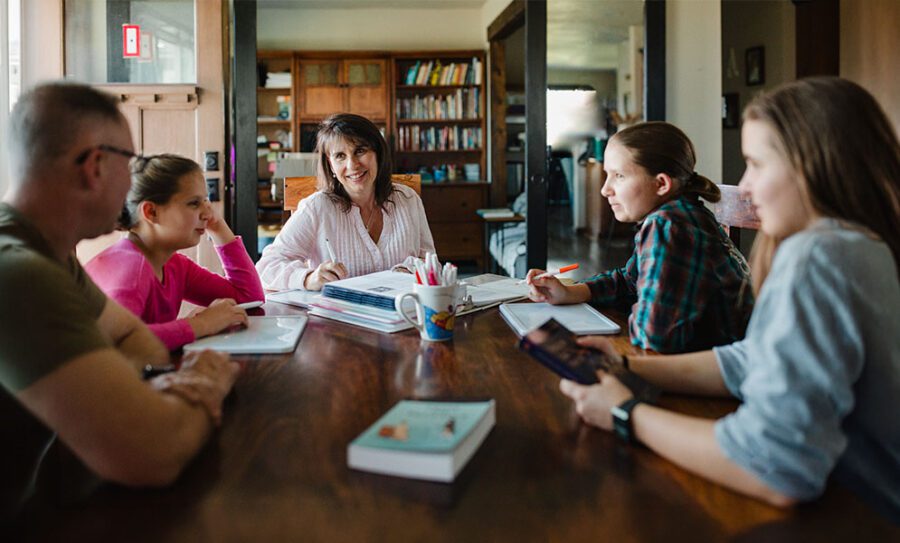
Try this as a family. Submit starts with naming one truth you are not currently practicing or a misalignment between what you say you believe and what your household actually does. Speak means saying that truth out loud together, at dinner, in the car, or wherever your family already talks. Publish means writing it down somewhere everyone can see it, such as a note on the fridge, the bathroom mirror, or the wall calendar, so it survives past the conversation that produced it. Convene means gathering around it on purpose and revisiting it as a family until it becomes a rhythm rather than a memory. Defend means guarding that rhythm when something outside the family, such as a schedule, a sports season, or a school calendar, pushes against it and tries to crowd it out.
John Adams wrote to the Massachusetts militia in 1798 with a warning that has outlasted the moment that prompted it: “Our Constitution was made only for a moral and religious People. It is wholly inadequate to the government of any other.”
A constitution cannot manufacture the people it requires. It can only presume them and hope they show up. Self-government does not begin in a voting booth. It begins in a living room, with a family willing to name a truth, speak it out loud, write it down, and gather around it until it becomes a shared way of life. That is not a metaphor for the five verbs. It is the five verbs, practiced on the only scale where self-government is actually learned before it is ever exercised anywhere else.
Submit. Speak. Publish. Convene. Defend. Practice them at your kitchen table this week, and you’re not just raising a family. You are building the kind of person the US Constitution was written for.
Written by: