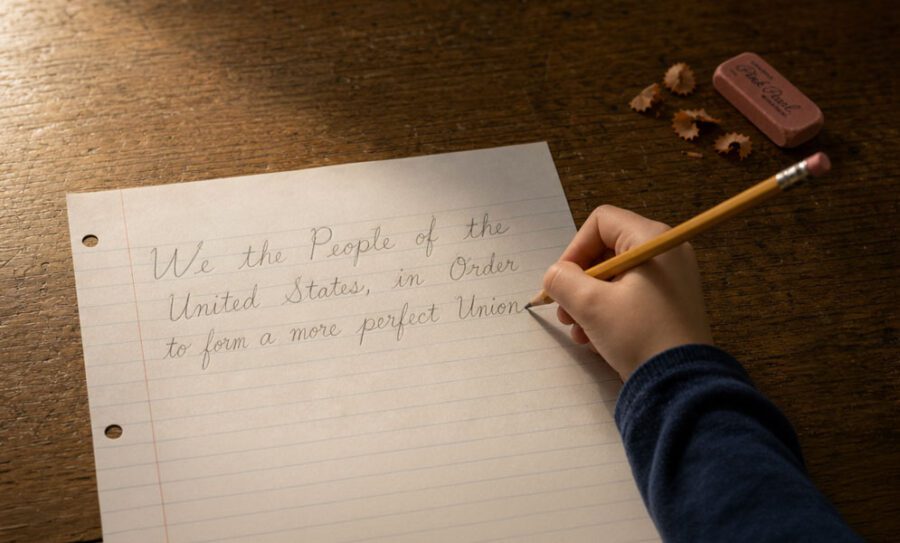
Steam curls from your coffee. Three children chant the Preamble to the United States Constitution around the table, and a fourth thumps a fist because someone stole his pencil. Voices climb. Chairs scrape. For one flickering moment, your quiet kitchen becomes a miniature Congress, complete with a mob.
You may know this scene. Every parent of multiple children can probably relate. In that small, loud moment, something enormous is happening: a soul is choosing between reason and passion, and you are training that soul to choose well.
A Founding Father’s Warning
James Madison spent much of his life writing about this exact collision. Under the pseudonym Publius, he warned that large assemblies, whether in Philadelphia or around a breakfast table, tend inexorably toward chaos when feelings outrun thought. In Federalist No. 55 (1788), he delivered one of the most quoted lines in American political thought: “In all very numerous assemblies, of whatever character composed, passion never fails to wrest the sceptre from reason.” Even a room full of philosophers, he added, would still dissolve into a mob: “Had every Athenian citizen been a Socrates, every Athenian assembly would still have been a mob.”
Madison did not trust unbridled passion to govern itself, and he did not suggest that the government should trust it either. As he put it in Federalist No. 49 (1788), “It is the reason, alone, of the public, that ought to control and regulate the government. The passions ought to be controlled and regulated by the government.” Reason, in Madison’s republic, sits on the throne. Tempered passion serves beneath it.
Because the framers built no monarchy and appointed no philosopher-king, Madison and his fellow delegates staked the whole American experiment on something far riskier and far more beautiful: the hope that ordinary citizens could learn to reason well enough to govern themselves. Jeffrey Rosen, president of the National Constitution Center, calls this Madison’s central gamble in an excerpt examining Madison’s enduring warnings, noting that Madison feared a republic could collapse from within long before any foreign army breached its walls.
Every Generation Relearns This Lesson
Madison was not the last to sound this alarm. Historian and speaker William Federer, chronicling Madison’s life and letters, traces how the fourth president grounded the whole constitutional project on “the capacity of mankind for self-government,” all while building in checks precisely because he knew that capacity had to be trained. Federer walks through Madison’s insistence that “ambition must be made to counteract ambition,” his blunt admission that “if angels were to govern men, neither external nor internal controls on government would be necessary,” and his flat warning that “all men having power ought to be distrusted.” (Read the fuller account in Federer’s profile of James Madison.)
Elsewhere, Federer reaches back to Fisher Ames, a contemporary of Madison’s who diagnosed the same disease in starker terms: “Few can reason, all can feel.” A democracy untethered from moral reasoning, Ames warned, becomes “a volcano which conceals the fiery materials of its own destruction.” Federer lays out the whole sobering case in his piece “What Happens in a Democracy without Morals?” and historian Allen Guelzo picks up the same thread later through Lincoln, who watched “the wild and furious passions” of mob violence threaten to replace “the sober judgment of Courts.” Guelzo’s essay “Government by Reason—or by Passion?” makes plain that this is not a Founding-era problem alone. It is a permanent, recurring one, resurrected in every generation that forgets to teach its children to think with reason.
The Trivium as Training Ground
As a teacher—because all parents are teachers—you are not merely instructing your children to memorize math facts or recite the periodic table, wonderful as those are. You are forming the very faculty Madison begged a republic to cultivate. The classical tradition calls this work the trivium: grammar, dialectic, and rhetoric. These are the arts of learning to know, to reason, and to speak well. Leigh Bortins puts the goal plainly in her book The Core: “Education is the cultivation of wisdom and virtue, and it is accomplished by nourishing the soul on truth, goodness, and beauty.” Elsewhere, she argues that “most real learning comes from wrestling with big ideas and arguing with another person.” That wrestling, that patient argument in the kitchen, is reason in training. Remember that reason sits on the throne for Madison. Every king needs a scepter. You are seeking to prepare your child to take up the scepter of reason. You forge that scepter yourself, blow by careful blow, in your home.
Freedom Is Not Indulgence
“Real freedom is not self-indulgence,” Robert Bortins, CEO of Classical Conversations, writes; “it is self-government.” He notes that “the classical tradition understood education as the ordering of the soul toward what is real, good, and beautiful,” and he reminds weary parents that “character is forged in difficulty, not ease.” (He further develops this point in “250 Years of American Liberty: Why Classical Conversations Families Serve.”) Every spelling list, every history date, and every stubborn math fact you practice quietly disciplines a soul that will someday cast a vote, sit on a jury, or decide alone in a hard moment whether reason or unbridled passion gets the scepter.
Classical educator Andrew Kern cautions against training only half the child. A full education, he argues, must touch every layer of a person at once, so that “the intuitive, the rational, and the passionate will all be touched by a well, a resource so deep that it flows through both the rational and irrational sides of us.” (More of his thinking is detailed in a profile from the Epoch Times.) Reason, in other words, does not conquer passion by ignoring it. Reason orders it, the way a conductor orders an orchestra rather than silencing every instrument.
Reason at the Breakfast Table
So when your children squabble over a pencil, and voices rise, and the whole kitchen threatens to become Madison’s mob in miniature, pause before you referee. Ask a question instead of issuing a verdict. Invite the wronged child to state his case, and invite the accused to answer it, because that single pause is the whole American project rehearsed in twelve square feet. You are not merely stopping a fight. You are training a future citizen to let reason seize the scepter.
The Quiet, Joyful Work
None of this feels dramatic. It feels like flashcards and a toddler underfoot while you diagram a sentence. Yet senators alone never sustained Madison’s republic. It survives or crumbles in kitchens exactly like yours, in the small, disciplined decision to teach a child to reason before he reacts.
Keep going. Keep asking questions instead of shouting answers. Keep memorizing, arguing, wrestling, and revising alongside your children, because every one of those quiet moments adds another citizen capable of self-government to a republic that still, two and a half centuries later, depends entirely on people like the ones you are raising.
Every generation still hands down the scepter. Make sure reason is the one that receives it.
Written by: