The election results are slowly settling in. While the economy and foreign relations were among the key issues in national races, was school choice a factor in state elections?
The Campaign Tell
In states that have passed publicly funded school choice, the answer is yes. Some campaigns ran ads warning that a particular candidate would take away voters’ school choice.
That strategy suggests that, at least in part, school choice was expected to help secure future political influence, at an increasing expense billed to the taxpayer.
That rising cost is the claim supporters will push back on hardest. Every school choice enthusiast reading this will want to shout, “Don’t you know a school choice student costs the taxpayer less than a government school student?” Yes, I do, and per student it is often true. The overall savings disappear, however, when most school choice students used to be privately funded. Even if that student’s education comes at a discount, it increases the cost to the taxpayer if the taxpayer was not paying for it before. In some states, even the per-student discount disappears at the state level. Texas will put $10,474 of state money into each private school student’s account for 2026–27, while the state contributed only about $6,200 per public school student in 2023–24, with local property taxes covering much of the rest.
Iowa shows how many of these students were already headed to private school. In June 2026, State Auditor Rob Sand, who is now the governor-elect, compared the state’s nonpublic enrollment projections, made before the ESA law passed, with actual enrollment. The state had projected 33,054 nonpublic students for the 2025–26 school year, while actual enrollment was 41,892. By Sand’s analysis, roughly 80 percent of ESA funds, about $258.7 million of the program’s roughly $329 million cost, paid for students who were already expected to attend private school. Sand, a critic of the program, was running for governor at the time, and Republican leaders called the report a political stunt. Sand says his numbers come from the Reynolds administration’s own published data.
Arizona tells the same story. The RAND Corporation estimated that about 71 percent of students in Arizona’s ESA program came directly from private schools or homeschooling, down from 79 percent earlier in the program. The state was not paying for those students before. The Grand Canyon Institute, a nonpartisan think tank that has criticized the expansion, put the net cost of universal eligibility at about $360 million in fiscal year 2025. Supporters point out that a growing share of new enrollees now come from public schools, a share the Arizona Department of Education puts at 56.5 percent of recent universal enrollees. How many of those families would have left public school anyway is impossible to know. Even so, most of the families in the program were already paying their own way before the state stepped in.
Read more about this failing strategy to buy votes here.
Arizona’s Test Case
The next layer of this failing vote-buying initiative is fresh in our minds. Arizona’s universal ESA program, a Republican-driven initiative often hailed as the gold standard of universal school choice, did nothing to slow the state’s new Democratic trifecta achieved through this last election. It is the first time Democrats have held the governor’s office and both legislative chambers since 1966.
Apparently, the program was not enough to keep Arizonans voting Republican, despite how often paid campaigns tell them to love it.
What the Sign Promises
If the program did not help the party secure future influence over the state, what might it have done?
Consider this image.
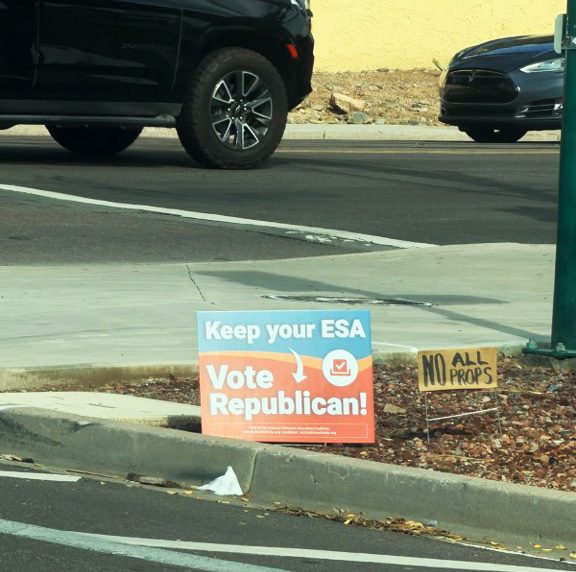
What is this sign other than a promise of state coffers opened for the private benefit of an individual family? It does not ask voters to defend a principle. It asks them to protect a benefit.
The sign is not an isolated tactic. In September, President Trump promised every adult citizen a $5,000 “Trump dividend,” but only if Republicans kept control of both the House and the Senate. The structure is the same: vote for our party, and the treasury opens for you. David Wessel of the Brookings Institution called the promise “an attempt to try and bribe people into voting Republican.” The yard sign makes the same offer on a smaller scale, with a family’s ESA in place of a federal check. Neither offer carried the day.
Per-Pupil Funding and the Shape of Socialism
Education used to be priced by what it would cost to educate the collective students in a state. The per-pupil funding model was a step toward acknowledging a reality: costly mass education programs are a form of forced wealth redistribution. Now that per-pupil funding drives allocations into individual accounts, it is getting harder to deny that these programs are redistribution schemes in their structure.
Republicans have promoted these programs as pathways to freedom and choice. All the while, they have been quietly conditioning conservatives to cheer on and demand socialism. At least as far as the mechanics go, Republicans have been reinforcing the normalization of socialist paradigms.
Change Must Come Gradually
In 1898, John Dewey wrote that “change must come gradually,” warning that to force it “would compromise its final success by favoring a violent reaction.” Change has come gradually, and the reaction never came. The most uncomfortable reality is that no political party seems to be standing in total opposition.
Consider the record since 2025. In August of that year, the Trump administration converted billions in CHIPS Act grants into a 10 percent government stake in Intel, and the president promised more deals like it. The sharpest objections came from inside his own party. Sen. Rand Paul called the deal “a step toward socialism,” and conservative radio host Erick Erickson called it “socialism with an R next to its name.” Add a promised $2,000 tariff dividend and the $5,000 “Trump dividend,” and the pattern is hard to miss. The party that once ran against government ownership and government checks now offers both. Swing voters are learning the lesson both parties are teaching: socialism is acceptable, and the only question is which flavor to pick. It should surprise no one that a record number of candidates backed by the Democratic Socialists of America won House seats this month.
At this point, we are just debating which kind of socialist programs we want: Republican or Democrat.
There is another option, and it is not new. Some of us see that both versions breed dependence, and we would rather be free. The path we are choosing is as old as time: paying our own bills and enjoying the freedom of being separate. Families who fund their own children’s education are obligated to no agency, wait on no appropriation, and should fear no election result. Some will object that compulsory attendance and regulatory laws do not always respect the privacy of private education. That is true, and sometimes that freedom has to be fought for. But even when we must fight for freedom, we must never lose the foundation it is built on: self-ownership. Authentic freedom has never depended on which party wins. It begins at home, with families who refuse to hand their children’s education to the state.
Written by: