
Why This Matters Now
Arizona’s House Bill (HB) 4037 never became law. It cleared two committees in February 2026, stalled on the House calendar, and died when the legislature adjourned for the year on June 13. However, bills rarely disappear for good. Ideas like this one tend to return under new bill numbers and friendlier names, often in more than one state.
Once a proposal is moving through a legislature, there is little time to study it. Hearings are short, talking points are simple, and the pressure to take a side comes quickly from its advocates. Now, while nothing is on the calendar, is the right time to understand how refundable tax credits, as proposed in HB 4037, work and what they would mean for homeschool families.
Two Kinds of Tax Credits
What is a tax credit? A tax credit reduces the tax you owe, dollar for dollar. The important question is what happens when the credit is larger than your tax bill.
A nonrefundable credit stops at zero. If you owe $830 and qualify for a $1,000 credit, your bill drops to $0 but no further. You don’t get paid out the difference. The dollars you keep are the dollars you originally earned. A nonrefundable credit allows families to keep more of their own money.
A refundable credit pays the difference. In the same example, you would owe nothing and receive a $170 check. That $170 never came from your paycheck. It came from taxes other people paid. A refundable credit looks like tax relief on paper, while in practice it redistributes money from one household to another.
The distinction is easy to miss because both are called tax credits and both are claimed on the same return. The label is the same. The mechanism and economic implications are not.
HB 4037 in Brief
Introduced by Representative Michele Peña in February 2026, HB 4037 would have created the Education Opportunity Tax Credit in a new section of Arizona’s tax code. Parents could claim a refundable credit for each school-age child who did not attend public school and did not receive money from an Empowerment Scholarship Account (ESA) or a school tuition organization (STO) scholarship. The amount was tied to the state’s per-pupil public school funding formula, known as the base support level:
- 80 percent of the base support level for a child who received no public school, ESA, or STO funding during the tax year
- 40 percent for a child who attended public school or received ESA or STO money for less than half the tax year
Because the credit was refundable and sized to public school funding, it would have been far larger than most families’ state income tax. That is where the math becomes important.
The Math: One Arizona Family
Consider a typical Arizona family of six—two parents and four children—earning about $81,500, close to the state’s median household income, according to the United States Census Bureau. After the standard deduction and existing credits for dependents, this family owes roughly $830 in Arizona income tax.
Under HB 4037, with all four children educated at home or in private school without an ESA or STO scholarship, the family would have qualified for about $25,280. The state’s nonpartisan fiscal analysis estimated the average credit at $6,320 per child.
| Amount | |
|---|---|
| Arizona income tax owed | $830 |
| HB 4037 credit (four children) | $25,280 |
| Paid out beyond what the family owed | $24,450 |
| Share of the credit that is other taxpayers’ money | 97% |
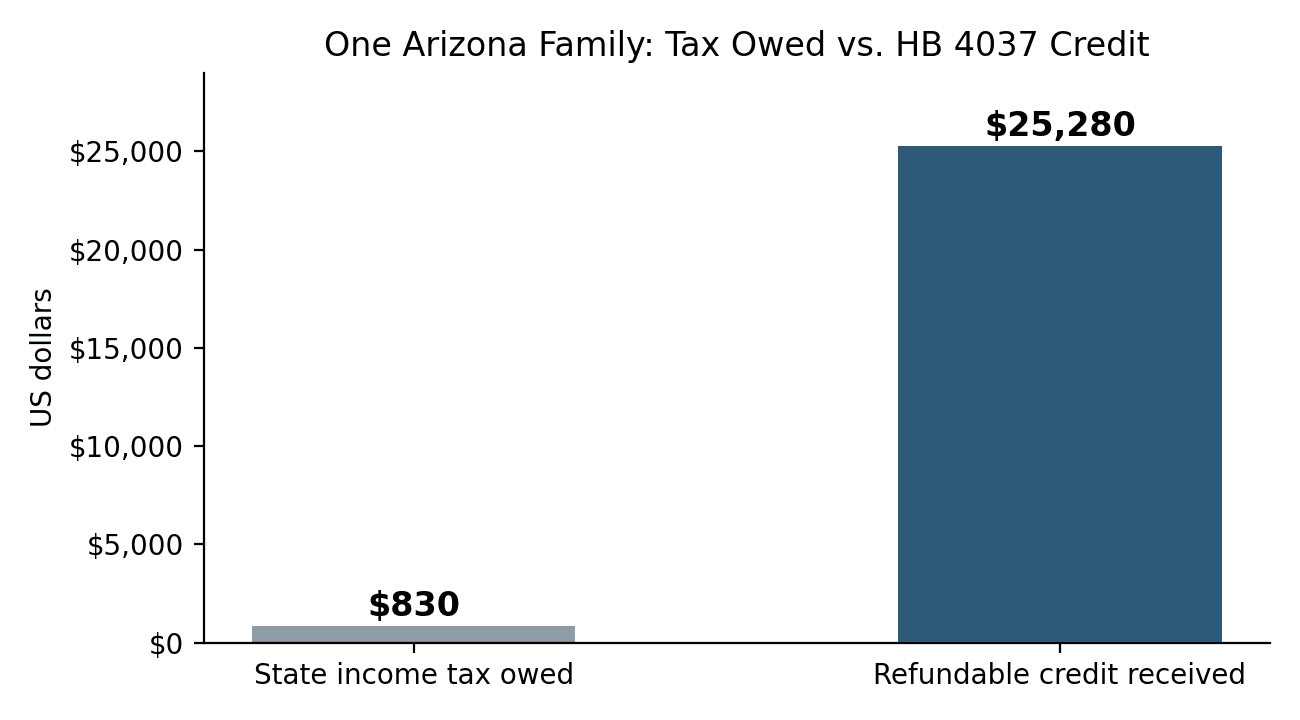
The first $830 of the credit would cancel the family’s tax bill. The remaining $24,450 would arrive as a payment from the state. In other words, 97 percent of the credit would not return this family’s money at all. It would be money collected from other taxpayers and redirected to this household.
That is the heart of the matter. For families who would have claimed it, HB 4037 was not a tax cut. It was a direct payment delivered through the tax code.
The cost would add up statewide. Arizona’s Joint Legislative Budget Committee estimated that about 43,000 students would qualify. If half of eligible families claimed the credit, state revenue would drop by $135.2 million every year. If all of them did, the loss would reach about $270.5 million.
The Case Against It
It is wealth redistribution. A program that takes money from one set of households and pays it to another is redistribution, whatever it is called and however it is delivered. Running the payment through a tax return changes the paperwork, not the substance. Families who believe the state should not take from one neighbor to give to another can hold that conviction here too, even if they would be the ones receiving the check.
Public money brings public accountability. When the state pays out money, it has a duty to verify that the money is used as intended. That duty is reasonable from the state’s point of view, which is exactly why it grows. Eligibility checks lead to verification, verification leads to reporting, and reporting opens a path toward oversight of what and how families teach. HB 4037 already directed the Department of Revenue to work with the Department of Education to verify how each child was educated, and Arizona’s ESA program shows how funding programs attract audits, investigations, and new rules over time.
It reinforces the wrong premise. Sizing a credit to the public school funding formula carries an assumption: that the state is responsible for funding every child’s education, and that families outside the system are owed their share. Accepting the payment quietly accepts the premise. Education is a responsibility of parents, and funding it is part of that responsibility.
A Better Response
The most fitting response to a proposal like HB 4037 is to leave the money on the table. That is not indifference toward families who are struggling. Many homeschool families make real sacrifices, and some genuinely need help.
Scripture offers a better model for meeting those needs. The early church shared so freely that no one among its members lacked (Acts 4:34). Paul urged believers to give “not reluctantly or under compulsion” (2 Corinthians 9:7, ESV). Generosity, when freely given, builds trust, strengthens communities, and honors both giver and receiver. Money collected by compulsion and redistributed by the state cannot do the same.
Families, churches, co-ops, and the private and charitable sectors already meet needs through scholarships, shared resources, and neighborly care. Supporting those efforts, and building more of them, is how we care for one another without surrendering the independence that makes home education flourish.
When the next version of HB 4037 appears, the goal is not alarm. The goal is understanding: knowing the difference between keeping your own money and receiving someone else’s, and choosing a better way.
Written by: