Part 9 of the Build an Ark series by Education Independence
The Breadth of the Ark
This piece completes the last layer of the series, where the “ark” meets the “how.” Rather than narrowing to a checklist like last month’s “how do we build it,” it both steps back to reflect on the big picture and steps in to provide an example.
As stated several times throughout this series, “Arking” is bigger than any one initiative. A long legacy stands with us: co-ops forming, churches opening their facilities, classical schools embracing service projects as fundraisers, state associations organizing, conferences gathering thousands each year, curriculum writers building the tools families use, sports teams and robotics teams materializing, and independent service providers meeting needs, all through voluntary association and without a single public dollar.
Arking, even though it is structured, looks less like a construction crew with one hammer and more like a symphony. Education Independence is one part in it, and we are delighted to play that part in harmony with others.
Thirteen Colonies, One Cause
History shows how individual parts can become a united whole. We forget there were once thirteen colonies, not one nation. Each had its own flavor, its own circumstances, its own experience of self-government. Alone, not one of them could secure independence.
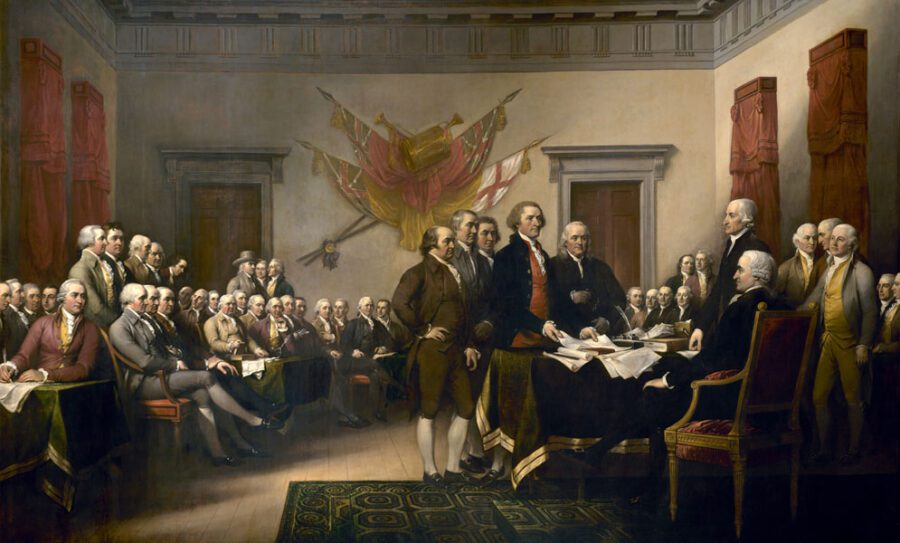
As Benjamin Franklin is said to have warned at the signing of the Declaration, “We must all hang together, or assuredly we shall all hang separately.”
The Declaration of Independence was a beautifully concise unifier. It did not express every opinion or address every problem the colonies faced. It was the bare minimum: a shared claim strong enough to unify without dictating. That claim turned thirteen separate efforts into one cause. It did not command collaboration; it invited it, and our young nation answered by serving and sacrificing for independence.
The Symphony Already Playing
We are practicing the same pattern right now. Picture a symphony: many instruments joining together for a specific piece. They do not play the same note. The beauty is in the harmony, in different lines and rhythms coordinated under one score. When each player submits to that score, the concert holds. That is what today’s independent education movement already looks like, and with more attention to our shared score, we can grow the symphony in both numbers and impact.
Our Section and Song
In Education Independence, we have been settling into our section. For now, we are not litigating, and we are not always on the front lines. Our part is defense, refinement, and vision casting. We sharpen the language and arguments the movement already reaches for, share them through writing, teaching, and conversation, and offer spaces to practice them. It is a good fit for who we are.
This series has been part of our own worked example. It offers the why, the what, and the how as one attempt at refinement.
We are not content to be theorists. We practice the four pillars of Education Independence in our education and advocacy, and we test the five verbs of building in our own work. We want to incubate and apply the timeless ideas of independence.
Tuning in Concert
Finding our section has taken time and contemplation, and it will need constant tuning as we play in concert with those around us. We seek to do our part faithfully alongside others. Together we can shelter and serve those escaping the flood, showcase the beautiful potential of freedom, and carry our independence forward for generations to come.
Written by: