“Parents have the right to choose what’s best for their family and have their education tax dollars pay for the school that meets their child’s needs.” —Arizona Department of Education
How State Budgets Work
State budgets belong to the people of that state — but not on an individual level. They belong to the collective body of citizens.
The Public Park Example
Imagine a public park. Perhaps it has walking trails, a pavilion, and a playground for children. People are free to enjoy the park as much as they want during the day, but if they try to access it after hours, they may face a trespassing penalty. This public park is a recreational area funded and maintained with taxpayer dollars, so taxpayers can enjoy the space together. But just because individual taxpayers fund the park does not mean they have permission to break the rules or treat the park how they see fit. The public park is not owned by any one individual, but rather a collective group of people who all pay for it.
As a collective, we agree to a “government contract” and delegate our authority to state legislatures, who represent us. The state legislature is then the one responsible for the state’s compulsorily funded budget.
Compulsorily Funded Budget Defined
Let’s pause for a moment. What does “compulsorily funded budget” mean? According to Merriam-Webster, compulsory means “mandatory, enforced.” It is not something voluntary; it is something required and nonnegotiable. This is what taxes are. The taxes we pay to our state are compulsory, and all those compulsory dollars flow into the state budget to fund various types of government services and programs. See the Tax Policy Center’s breakdown of the sources of revenue for state and local governments in 2021 for a deeper explanation.
Representative Budgets
Since we have a representative democracy rather than a direct democracy, budget decisions are made through the state legislature as our representative body. Governmental issues have always been complex, and the sheer number of citizens makes direct participation in every government decision logistically impossible. Therefore, individual citizens cannot direct how their specific tax dollars are spent. Education funding works the same way; it comes from the collective budget, allocated by the legislature.
Understanding where education funding comes from is crucial because it reveals why the “school choice programs give your tax money back” argument fails. Let’s look at what families actually contribute versus what they receive.
The Numbers
State education budgets are funded primarily by taxpayers who don’t have school-age children. According to the 2024 U.S. Census Bureau estimates, approximately 61% of family households do not have children under eighteen. When you include non-family households (single people living alone, roommates, etc.), the percentage of households without school-age children is even higher. In order to understand how this applies to state education budgets, let’s look at some data taken from national averages:
- The median household income in 2024 was $83,730.
- The average per capita state and local tax burden in 2025 was $7,109.
- The average effective state and local tax rate paid by residents to their states is:
◦ 11.4% for the lowest-income families and individuals,
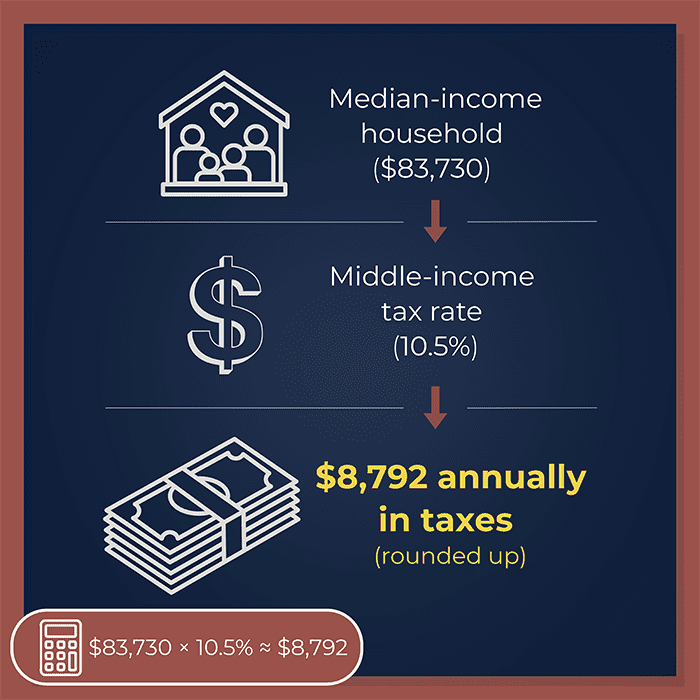
◦ 10.5% for the middle-income bracket, and
◦ 7.2% for the top one percent.
Using this data, we can make a few calculations. If a median-income household ($83,730) pays the middle-income tax rate (10.5%), that means they contribute approximately $8,792 annually in state and local taxes.
More than one-fourth of state spending, on average, goes toward public education. The average money an education savings account (ESA) program in Arizona distributes to a family is between $6,000 and $9,000.
This means if 25% of state budgets go to education, then only about $2,198 of the $8,792 household tax amount goes to education.
The numbers simply defeat the idea that school choice gives families their tax dollars back. A family receiving one $7,000 ESA can only claim at most that approximately $2,200 of it (31%) represents their own education tax contribution — the remaining $4,800 comes from other taxpayers. But that 31% that represents tax contribution is not a one-to-one refund of that family’s taxes because it comes from the state’s collective budget. Instead of framing school choice as a refund, we should recognize it for what it is: a redistribution of collective funds.
The Majority Pays for the Minority
This redistribution raises fundamental questions about fairness and the proper role of public funds. These questions become more pressing when data shows that most ESA recipients were enrolled in private schools previously, meaning the majority of taxpayers (particularly those without school-age children) are funding the choices of a minority of families who were already choosing private schools with their own money. Read our article about school choice and low-income families to learn more about low-income vs. high-income families and their relationship to school choice policies.
Conclusion
When families receive $6,000–$9,000 in ESA funding but only contribute roughly $2,200 in education taxes, they’re not “getting their money back.” They are receiving a taxpayer-funded government grant (or subsidy) that is three to four times their contribution. The question isn’t whether families have the right to choose private education — families absolutely have the freedom to choose how to educate their children. The question is whether all taxpayers should be compelled to subsidize those private choices with public funds, particularly when the subsidy is three to four times what participating families contribute.
This conversation matters because we need to be accurate in our thinking. School choice funds come from a compulsorily funded pool of public dollars, and they redistribute those funds from the majority to the minority. School choice isn’t being truthful when it says it gives families their tax dollars back; it is nothing more than an advertising slogan that isn’t backed by the numbers or the truth behind state budgets.
Written by: