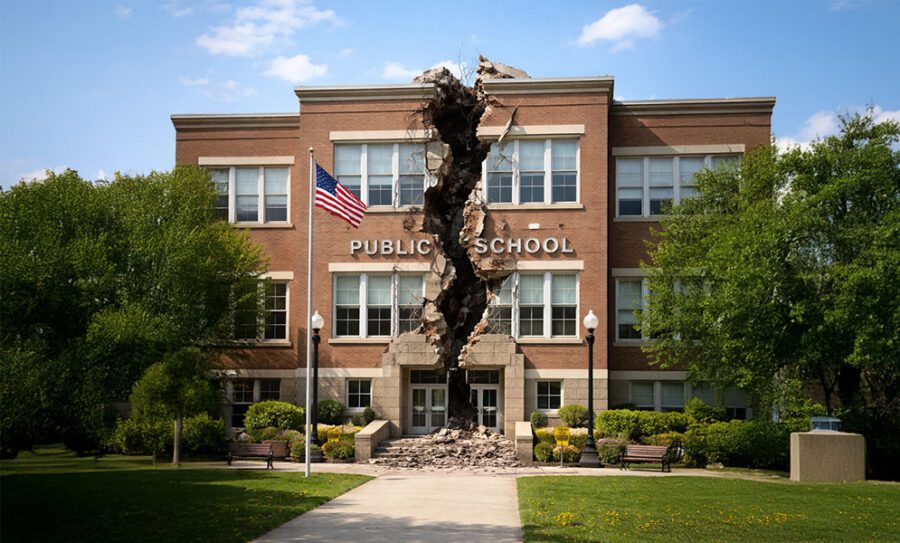
Key Takeaway: Education movements must shift from focusing on what they oppose. Instead, they need to show what they are building. This article shows how to create a lasting vision for parent-led education.
Reclaiming a Positive Vision for Education Independence
In freedom-minded communities, resistance becomes a second language. Many people can spot bad ideas, bad policies, and bad outcomes quickly—and learn to speak passionately about what they oppose. That vigilance is necessary.
But vigilance alone is not a vision. And if we only know what we are against, we may eventually lose clarity about what we are building. Scripture reminds us that there is real value in vision; Proverbs 29:18 KJV says,
“Where there is no vision, the people perish: but he that keepeth the law, happy is he.”
If we only know what we oppose, we still do not know where we are going, or what we are building in its place. A strong and clear vision—rooted in truth—gives direction, clarity, and accountability to a shared objective.
The Problem: Defining Freedom by What It’s Not
So much of the privately-funded, parent-directed education movement is defined by what it is not. We often rally around what we oppose—what we refuse, what we resist, and why we reject the alternative. In many ways, this mirrors broader conversations about freedom in our culture.
And while vigilance is necessary, there is a quiet danger in spending most of our energy whistle-blowing and naming threats. Over time, people may grow fluent in opposition but lose clarity on what we are building—what freedom is, and what we can and should do with it. That vacuum of a clear positive vision is often misunderstood as selfishness.
Occasionally, the freedom-minded crowd is accused of being concerned only with themselves and their own rights. In some cases, that accusation may be true. But in many cases, it is a misunderstanding. Many people join freedom movements out of love for their neighbors and concern for generations to come—and they may never personally receive the benefits of what they defend. In doing so, they often make significant sacrifices for the freedom of others, at steep cost to themselves. The reality is that the space to live freely must be fiercely protected—and protected proactively—not only for those who enjoy freedom now, but for those who will depend on it later.
Even those who only briefly brush up against free cultures are positively affected by proximity. Freedom, when protected and practiced faithfully, blesses more people than its defenders can possibly count.
The Truth About Educational Freedom Advocates
Our nation was founded on that kind of forward-thinking, sacrificial paradigm. The people who championed liberty were willing to give up their rights—even their lives—to secure rights on behalf of others. That “others-focused” commitment is not a contradiction to freedom; it is part of a cohesive freedom paradigm.
This others-focused understanding of freedom may be most clearly exemplified by the testimony and commitment of the signatories of the American Declaration of Independence. When they put their names to the document, they were not merely asserting a political preference or protecting personal advantage. They were publicly binding themselves to a cause which costs they fully understood—and whose benefits many of them would never live to enjoy.
Learning from America’s Founders
They concluded their declaration with these words:
We, therefore, the Representatives of the united States of America, in General Congress, Assembled, appealing to the Supreme Judge of the world for the rectitude of our intentions, do, in the Name, and by Authority of the good People of these Colonies, solemnly publish and declare, That these United Colonies are, and of Right ought to be Free and Independent States; . . . And for the support of this Declaration, with a firm reliance on the protection of divine Providence, we mutually pledge to each other our Lives, our Fortunes and our sacred Honor.
That pledge captures something essential: freedom is not merely defended by those who want comfort, but built by those willing to carry responsibility for the sake of others.
This series is an attempt to apply that same forward-thinking, vision-crafting narrative to Education Independence. Instead of defining ourselves primarily by what we are not, we intend to clearly define what we are. We want to build a vision for why education independence matters—not only for those already in this space, but for everyone.
From Resistance to Construction
What we are building is not merely an alternative. It is a refuge. It is a durable, generationally-minded space of formation and freedom.
To describe the kind of work education independence requires, we need imagery and narrative that match both its urgency and its hope.
An ark is more than a shelter from the storm. It is a structure built ahead of time, with courage and conviction, for the sake of others. It is warm, cozy, hospitable, welcoming, roomy, and accommodating. Most of all, it is sturdy and maintainable for whatever storms may come.
Floodwaters of power and influence demanding control rise in different forms across generations. History has shown that tyranny always seeks to drown the individual’s right to carry his own responsibilities. If we are going to preserve a future in which families can direct the education of their children in freedom, we will need to build something strong enough to endure.
So, we are not only responding. We are building.
We are going to build an ark.
The “Build an Ark” Series: A Roadmap for 2026
This is the first installment in a series titled “Build an Ark,” which will serve as the Education Independence Initiative’s centerpiece for 2026. The goal is simple but necessary: to move from reaction to construction.
In the privately funded, parent-directed education space, much of our energy is spent explaining what we are not. That is understandable. Many families arrive here because something in the broader educational culture feels misaligned, unsafe, or unsustainable.
But opting out is only the beginning.
Over the course of this series, I will be building a positive, forward-looking vision for education independence—what it is, why it matters, and how to cultivate it in a way that is sturdy enough to endure.
Here is how the series is structured:
- February: Introduction
- March–May: Why Build an Education Independence Ark
- June–August: What Is an Education Independence Ark
- September–November: How Do We Build an Education Independence Ark
- December: Conclusion
This same framework will also serve as the backbone of our seminar content, with guest voices joining throughout the year to strengthen, expand, and apply these ideas.
My hope is that this series will offer more than arguments. I hope it offers a vision—one that helps families not only defend freedom in education, but build something good within it, in love and service to Christ and our neighbors.
Written by: