This belief drives both the public school system and school choice programs, such as education savings accounts (ESAs), which redistribute tax dollars to help families pay for alternatives to public schools.
But this assumption is relatively new. For most of American history, education was the family’s responsibility, not the government’s. The Founding Fathers, America’s pioneering inventors, and generations of successful citizens were educated without government schools. The idea that the state should control or fund children’s education is rooted in collectivism—the belief that individuals must surrender autonomy to the government for “the greater good.” Sometimes, collectivism is beneficial, and “the greater good” is something we should strive for. But this is not the case for education.
The Problem
Over the past century, this belief has transformed education in America. Today, parents face a government-centered choice for the “greater good” of society: send your children to the local public school or accept government funding to attend an alternative private school option. Either way, the government maintains ownership—whether through direct operation of schools or through the strings of “free” public dollars.
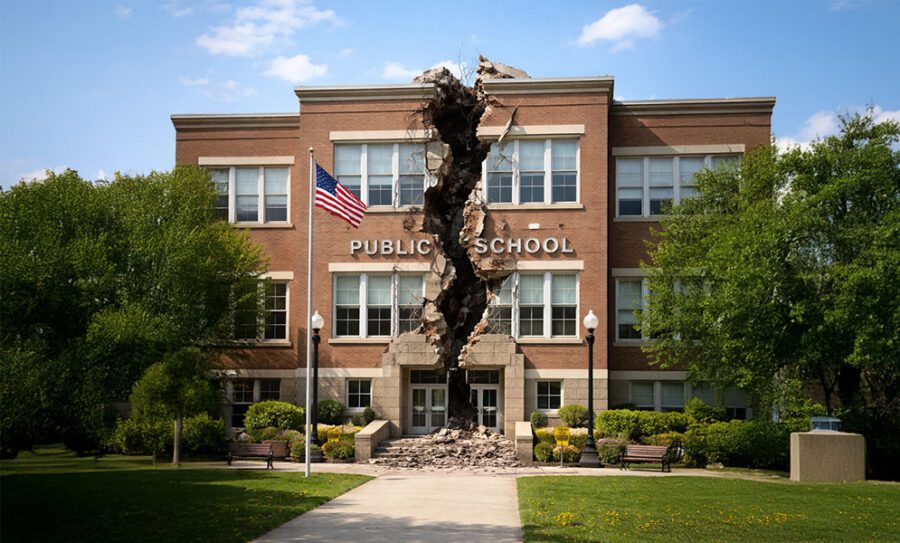
What has this “greater good” actually delivered for children? The issue isn’t which government program delivers the education, but that government is delivering it at all. Public schools and ESAs are two doors into the same system. Both operate on the premise that the state—not parents—bears primary responsibility for children’s education. Both use redistributed tax dollars. Both come with strings attached to the government via public ownership. Both are systemically flawed.
The Data: Government Schools Are Broken
Consider the evidence from government schools themselves—and remember, the same government in the driver’s seat of public schools is the one offering you school choice money.
1. Staggering Illiteracy Rates
- Not one state saw reading gains from 2022 to 2024.1
- Only 31% of 4th graders performed at or above the proficient level in 2024 (a decline from 35% in 2019).1
- 54% of adults have a literacy below a 6th-grade level (20% are below 5th-grade level).2
- In 2024, 21% of adults in the US were illiterate.2
2. Historic Learning Losses
- 33% of 8th graders read below a basic level, which is the highest percentage ever recorded.1
- Reading scores for 9-year-olds dropped 5 points from 2020 to 2022—the most significant decline since 1990.3
- Mathematics scores for 9-year-olds dropped 7 points from 2020 to 2022—the first-ever score drop in mathematics.3
3. Pointless Spending Increases
- Per-pupil spending rose to $15,633 in 2022, the largest increase (8.9%) in over 20 years.4
- Total public-school spending approached $1 trillion in 2023.4
- Despite a 13% increase in per-pupil spending from 2010 to 2020 (adjusted for inflation), reading and math scores continue to decline.4
4. Mental Health Crisis
- In 2023, 40% of high school students reported experiencing persistent sadness or hopelessness.5
- Only 48% of schools report being able to effectively provide mental health services to students who need them (a decline from 56% in 2021–2022).5
- 69% of schools reported increased students seeking mental health services, but only 49% offer diagnostic assessments, and 38% offer treatment.5
Despite spending nearly $1 trillion annually and dramatically increasing per-pupil expenditures, government schools are producing record-high illiteracy rates, historic learning losses, and a mental health crisis that they cannot address. More government control and funding have not equated to better outcomes for children, nor will they.
The Case for Ownership
The government has proven itself wholly untrustworthy with children’s education—and why would we expect otherwise? Unlike parents, the government faces no real consequences for failure. Parents can’t fire school administrators or demand refunds from local governments for wasted years. But parents bear the lifelong impact of their children’s education, which creates natural accountability that no government system can replicate.
The evidence doesn’t call for better government management of education. It calls for an entirely different paradigm: parents reclaiming the responsibility that was always theirs. Whether you consider biblical principles (Deuteronomy 6:6–7) or American legal precedent (Pierce v. Society of Sisters), the education of children is fundamentally a parental responsibility—one that predates and supersedes government claims.
More importantly, this is a matter of fundamental rights. Parents hold natural authority over every other aspect of child-rearing—healthcare, moral formation, religious instruction. Educational formation is no different. School choice programs don’t solve this problem; they merely repackage government control with taxpayer dollars and label it as freedom. True education freedom means parents taking full ownership and not accepting another form of government dependency dressed up as choice.
Further Reading:
- “School Choice Tax Funding Is Cheese in a Mousetrap”—Read about how “free” school choice programs use taxpayer funding and promise freedom while delivering government control.
- “Public Education Expansionism: The Result of School Choice”—Read about how school choice programs paradoxically strengthen and expand the public education system rather than offering a true alternative.
- “The Forgotten History of the Public Schools”—Read about the men who crafted the ideologies and systems behind today’s failing public school system.
Sources:
- The Nation’s Report Card: “Explore Results for the 2024 NAEP Reading Assessment.”
- The National Literacy Institute
- National Center for Education Statistics: “Long-term trends in reading and mathematics achievement.”
- United States Census Bureau: “Largest Year-to-Year Increase in Over 20 Years for Public School Spending Per Pupil.”
- National Center for Education Statistics: “Mental health services in public schools.”
Written by: