Article summary: A choice was posed between being right and being kind. That choice reveals something larger: over the past 150 years, public institutions have steadily assumed the authority of the family and the Church in forming the moral character of children. Through programs like social-emotional learning, the State now shapes the attitudes, behaviors, and values of the next generation—authority that has never properly belonged to it.
Traveling through central North Carolina, I noticed a peculiar quote on a public middle school sign that one would expect to see on a chapel sign. It read “When given the choice between being right or being kind, choose kind.” This quote prompted a moment of pause to consider why an institution whose primary purpose should be the honing and precision of academic pursuits would be so invested in kindness. A conflict arises.
Should You Be “Right” or “Kind”?
Did the school choose accurate words in their message? Why a choice between right and kind? Why an either-or and not a both-and?
If kind means “to have or show a friendly, generous, and considerate nature that seeks the genuine good of another person, acting for the well-being of others,” wouldn’t academic institutions wish for accuracy as well as kindness?1 Or did the school mistakenly assume “kind” to be a synonym for “nice“? To be nice means to remain pleasant or agreeable with the goal of avoiding conflict or discomfort.2 In fact, the etymology of the word “nice” derives from the Latin “nescius” (not-knowing), and referred to persons who are foolish, ignorant, or senseless.3
Being right is not an act of unkindness; indeed, it is an act of kindness. To be right and be silent is to be nice, implying that the receiver of the information is incapable of accepting the truth.
The Church and Moral Formation
Considering the question at hand, should a public education institution have the authority and duty to assume the primary role in forming the moral character of children?
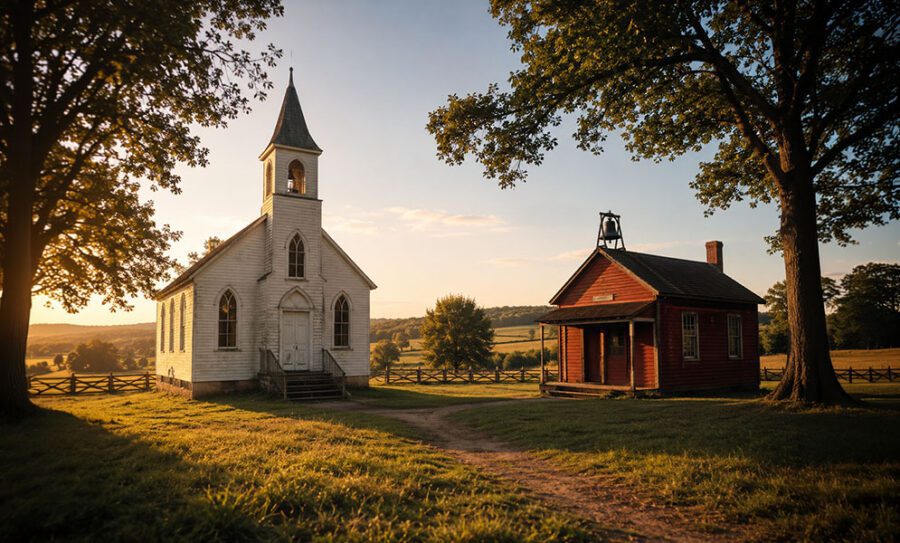
In the past, virtue and moral formation were first taught in the family and then reinforced within the Church. The parish Church served as the center of community life. Families gathered there not only for worship but also for academic instruction, moral formation, and the transmission of civic and religious traditions. Within Christian communities, the Church was the institution responsible for shaping children’s moral and intellectual development. Clergy and teachers instructed the young in Christian ethics, civic responsibility, and academic learning.
As Americans settled across the country, the Church was the center of every community. It was one of the first structures built, and both heavenly and secular business was conducted there. So, what happened?
The Public Schools and Moral Formation
Until the Industrial Revolution, the parish Church was the focal point of community life. When moving to a new location, the first question asked was, “What denomination of the Church is present and where is it located?” Now, the primary questions for most families are “How good are the schools?” and “How close can we live to school and employment?”
In the span of 150 years, the idea of the Church supporting the family in the teaching of civic virtue has been turned on its head, and now the public school is responsible for teaching both virtue and academics. During the nineteenth century, reformers such as Horace Mann, often called the father of the American common school, advocated for a system of state-funded public education designed not only to teach academic subjects but also to form the moral character of future citizens.
Education in an Industrialized Nation
As these common schools expanded alongside the industrializing nation, families and communities increasingly ceded to the government the authority to educate and morally form their children. The government has taken the authority to teach kindness from the parents and given it to a bureaucracy designed to inculcate dogmas that demand compliance. In recent decades, this authority has increasingly been exercised through programs such as social-emotional learning (SEL), promoted nationally through organizations like the Collaborative for Academic, Social, and Emotional Learning (CASEL), which encourage schools to shape students’ attitudes, behaviors, and social values alongside academic instruction.
The shaping of attitudes, behaviors, and social values is the mission of the family and the Church. Yet that authority has increasingly been transferred from parents to public institutions. The work, Woke and Weaponized: How Karl Marx Won the Battle for American Education and How We Can Win it Back, by Robert Bortins and Alex Newman, discusses a critical point: discipleship is the responsibility and the authority of the family and the Church.
The Capture of Moral Formation
A description of discipleship which expresses the authority and responsibility of the family to both civic and academic virtue is captured in Proverbs 22:6: “Train the young in the way they should go; even when old, they will not swerve from it.”4 The government, through public institutions, has subverted the authority described in discipleship from the family and the community. Public schools and institutions that apply the SEL model place more emphasis on being nice than being right. SEL places emotional consensus, identity affirmation, and conflict avoidance over objective truth.
These institutions have convinced families that they have the authority and responsibility to impart civic virtue.5 These same institutions, whose entire purpose should be on academic precision, choose not to properly articulate the difference between “kind and nice.”
Public schools are not places of enlightenment; instead, they indoctrinate students to comply with a pernicious doctrine that places the government at the center of education. As they mature in the system, these students become the priests and ministers of this indoctrination dogma to future generations.
For generations, Churches and communities formed the moral framework of communities and prepared pastors to pass those teachings to the next generation. In many respects, public institutions now carry out a similar formative role. Churches once formed doctrine and trained pastors to teach and preserve it. Through programs such as SEL and other institutional frameworks, schools increasingly shape students’ attitudes, behaviors, and values in ways that resemble the transmission of a civic orthodoxy.
The Next Question to Consider
The process of formation has not disappeared; it has simply changed hands. Yet the authority to form the moral character of children has never properly belonged to the State. If schools are forming children’s moral character, then the questions parents must ask are simple: Who is discipling our children—the family and the Church, or the State? What is the end-goal of the State’s intervention?
Notes
- The definition of “kind” is developed from the Summa Theologiae, Question 23, Article 1, by St. Thomas Aquinas, and Merriam-Webster.
- Definition of “nice” via Merriam-Webster. See also the link in the text above.
- From the Online Etymology Dictionary, “Origin and History of nice.” Accessed 8 March 2026 at etymonline.com.
- Passage comes from the New American Bible, Revised Edition 2011. The author chose this particular translation because it encompasses the full spectrum of discipleship. Other passages state, “Train up a child in the way he should go,” which limits the impact of the family, authority, and responsibility in imparting Christian and Civic virtue to future generations.
- See Chapter 7, p. 68 of “Woke and Weaponized: How Karl Marx Won the Battle for American Education and How We Can Win it Back” for a detailed insight into the social-emotional learning model.
Written by: